Somewhere in a hall cupboard, wrapped in tissue paper that was once white, there is a christening gown worn by three generations of your family. Or perhaps it is your mother's wedding veil, a lace handkerchief carried down the aisle, or a silk scarf that still smells faintly of your grandmother's perfume.
These pieces hold more history than almost anything else a family owns. But here is the hard truth: fabric packed away in a box is not standing still. It is ageing, often faster than you would expect, and the very materials used to store it may be doing the damage.
In this guide, our framers explain why delicate fabrics deteriorate, which common framing and storage materials quietly harm them, and how conservation framing lets you protect your heirlooms while finally bringing them out where they can be seen and loved.
To preserve heirloom textiles, keep them away from acidic wood-based materials, UV light and humidity. A conservation framer mounts the fabric onto acid-free, fabric-covered board using hand-stitching or stainless-steel pins, uses spacers so it never touches the glass, and seals it behind UV-filtering glazing. Done properly, the process is fully reversible.
The Heirlooms Families Bring to Us
Every week, families walk into our stores carrying something irreplaceable. Some of the textiles we are most often asked to preserve include:
- Wedding dresses, either the whole gown in a deep shadow box or a treasured section such as a lace bodice, beaded panel or length of train
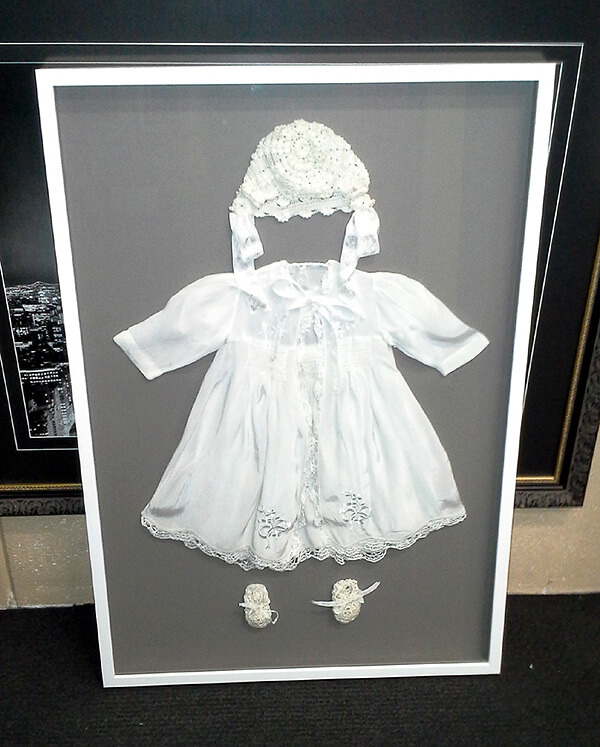
- Christening and baptism gowns, often handed down through several generations
- Wedding veils and lace, from cathedral-length veils to small lace collars
- Doilies, table runners and embroidered linen made by a grandmother or great-aunt
- Baby booties, bonnets and first outfits
- Quilt squares and samplers stitched by hand
- Silk scarves and other fine fabric accessories
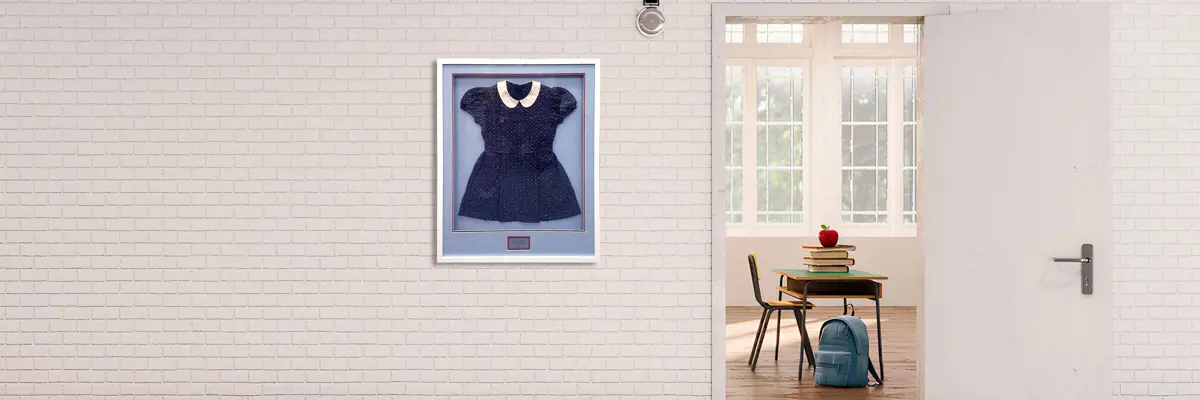
- School uniforms, such as a school dress kept from a first day or a final year
- Blazers, from school, club or sporting association blazers complete with embroidered crests and badges
- Cultural garments and textiles, from possum skin cloaks, woven fibre pieces and NAIDOC shirts to Māori korowai and piupiu, kimonos and ceremonial dress
- T-shirt mementos, like a concert tour tee framed with the tickets, wristbands and photos from the night
Framing a wedding dress
A wedding dress is one of the most common textiles families want to keep, and one of the most poorly stored. Gowns are usually boxed after the day, sometimes in sealed "preservation boxes" made with materials that are not truly acid-free. Years later the box is opened to find yellowing along every fold.
Framing gives you two good options. A full-gown shadow box displays the entire dress on a custom-shaped, conservation-grade form with enough depth to keep the gowns shape. A partial display frames the part that means the most, often the lace bodice, a beaded panel or a section of the veil, alongside a wedding photo or invitation. Partial displays suit smaller walls and are a lovely way to share a single gown between siblings, with each person receiving a framed piece.
From our workshop: Ceremonial wedding sashes
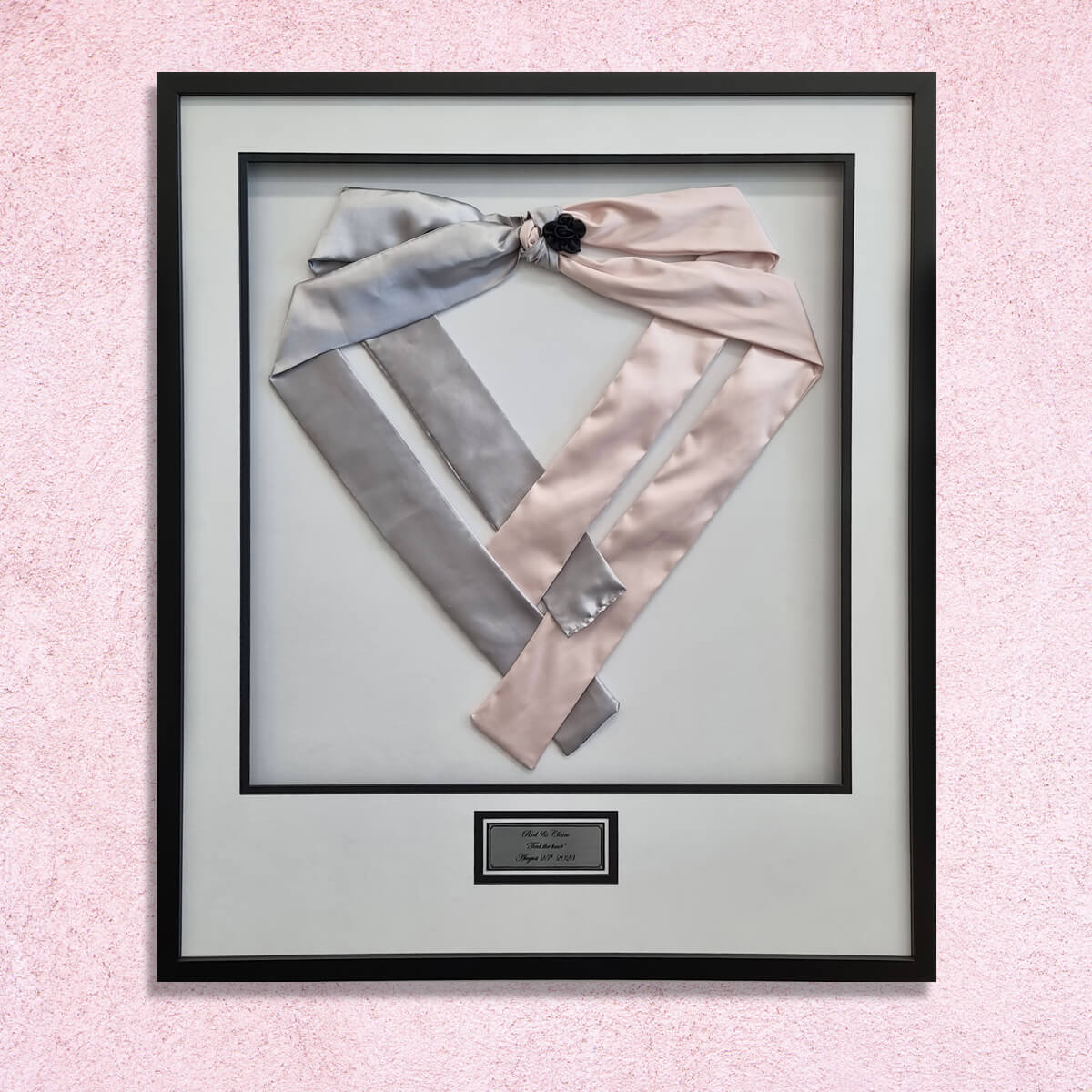
When a newlywed couple visited our Mittagong store, they brought with them something far more meaningful than a photo from the big day: the two ceremonial sashes tied together during their wedding ceremony.
The grey sash represented the groom and the pink sash the bride, knotted together as a symbol of their commitment to each other. At the centre sits a black rosette, the colour of the bridal party, which included the couple’s children, so the whole family is part of the piece.
Our framer Meagan carefully pinned the sashes into the shape of a love heart, letting the satin fall in soft, natural folds rather than pressing it flat. She set the piece behind a double mat for depth and added an engraved plaque recording the couple’s names and wedding date. The result is a memento that tells the story of their day every time they walk past it.
If you are framing stitched work such as cross stitch or tapestry, see our guide to needlework framing. For uniforms, sporting jerseys and other mementos, explore our memorabilia framing service.
The Science of Why Old Fabrics Fall Apart
Fabric deteriorates because its fibres are slowly broken down by light, acids, moisture and pests. Every textile is made of long chains of natural or synthetic molecules, and once those chains start to break, the fabric loses strength, colour and flexibility. Here are the main culprits.
Light - the fastest silent damage
Ultraviolet (UV) and visible light fade dyes and weaken fibres from the surface inward. The damage builds up with every hour of exposure and cannot be reversed. Silk is especially vulnerable. Over time, light-exposed silk can become brittle and split along the weave in a condition known as "shattered silk", where the fabric literally cracks apart when touched.
Acid - the hidden enemy in everyday materials
Acids are one of the most common causes of yellowing and brown spotting in old textiles. They migrate from surrounding materials such as cardboard, ordinary tissue paper and wooden drawers into the fabric. Cotton and linen lace are particularly susceptible, as acid gradually breaks down the cellulose in the fibres until they crumble.
Humidity, heat and Australian conditions
Australia's climate is tough on fabric. In humid coastal and subtropical areas such as Brisbane, Newcastle and the Central Coast, moisture encourages mould, mildew and brown "foxing" spots. In hot, dry spaces such as roof cavities, garages and sheds, fibres dry out, become brittle and stress as temperatures swing between day and night.
Insects, folds and handling
Silverfish are attracted to the starch used to stiffen linen and lace, and will graze on it, leaving thin patches and small holes. Clothes moths and carpet beetles attack protein fibres like silk and wool. Folding causes permanent crease lines where fibres weaken and eventually split. Even handling leaves behind oils and salts from our skin that discolour fabric over time.
How each fibre ages
Different fabrics face different threats. This quick reference shows what to watch for.
Fibre | Main threat | Warning signs | Best protection |
Silk | Light, acids, alkaline materials | Splitting, shredding, loss of sheen | UV glazing, unbuffered conservation board |
Cotton and linen lace | Acids, humidity | Yellowing, brown spots, brittleness | Acid-free mounting, sealed frame |
Wool | Insects, alkaline materials | Holes, thinning, felting | Sealed back, pest-free mounting |
Synthetics and blends | Light, heat | Fading, stiffening | UV glazing, stable display location |
Why Wood-Based Backings Harm Silk and Lace
Standard picture framing materials such as MDF, hardboard, plywood and ordinary cardboard are made from wood pulp. Wood contains a natural compound called lignin, along with acids left over from manufacturing. As these materials age, they break down and release acidic compounds, and some give off gases that become trapped inside a sealed frame.
Any fabric touching that backing slowly absorbs the acid. The result is yellowing, brittleness and brown "burn" lines that often match the exact shape of the board behind the fabric. Because the damage happens out of sight, many families only discover it when they take the frame apart years later.
The same problem applies to storage. A wedding dress or christening gown packed into an ordinary cardboard box with standard tissue paper is sitting in an acidic environment, often in the hottest or most humid part of the house.
Other common culprits
- Glue, double-sided tape and hot-melt adhesive, which stain and become impossible to remove
- Iron-on or fusible backings, which permanently bond to the fibres
- Staples and ordinary dressmaker's pins, which rust and leave orange stains
- Glass placed directly against the fabric, which traps condensation and encourages mould
A detail many framers miss
Many "acid-free" boards are buffered with an alkaline reserve to neutralise acids over time. That works well for paper, but protein fibres such as silk and wool can be harmed by alkaline conditions. For these fabrics, specialist framers use unbuffered conservation or RAG board.
How Frame Today Framers Mount Delicate Fabrics
Conservation textile framing is slow, careful work. Our framers follow a process designed around one principle: nothing we do should harm the fabric, and everything we do should be reversible.
Step 1: Assessment and consultation
Every piece starts with a conversation. We look at the fibre type, condition, size and weight, and talk with you about which side or section you would like on display and where it will hang. We will not wash, iron or repair a fragile heirloom without discussing it first, and if a piece needs specialist cleaning or stabilisation, we refer you to a textile conservator before framing.
Step 2: A conservation-grade foundation
The fabric is mounted onto acid-free, lignin-free board, covered with a neutral fabric that is washed and free of dyes and starch. This creates a soft, stable surface that supports the textile evenly and gives stitches something gentle to hold onto.
Step 3: Hand-stitching to suspend fabric naturally
For most heirloom textiles, hand-stitching is the gold standard. Using fine thread, our framers pass each stitch through the open spaces between the threads of the weave rather than through the fibres themselves. The stitches are spread across many small points, so the weight of the fabric is shared evenly and no single area is strained.
The result is a textile that appears to float naturally, held securely without glue or tension. Because nothing is bonded to the fabric, the stitches can be snipped and removed at any time, leaving the heirloom exactly as it was.
Step 4: Stainless-steel pins for the most fragile pieces
Some textiles, such as very fine lace or shattered silk, are too delicate to stitch. For these, our framers use stainless-steel pins, which will never rust and stain the fabric the way ordinary steel pins can. The pins are placed through the open spaces in the lace and into the padded board beneath, holding the piece in position without piercing or gluing the fibres.
Step 5: Depth, spacers and shadow boxes
Fabric should never touch the glass. Our framers use spacers to create an air gap between the textile and the glazing, which prevents condensation and contact damage. Three-dimensional pieces such as wedding dresses, christening gowns, bonnets and booties are framed in deeper shadow boxes, so they keep their natural shape instead of being flattened.
Step 6: UV-protective glazing and a sealed back
Finally, we recommend that the frame is fitted with UV-filtering glass to slow fading, and the back is sealed to keep out dust, insects and moisture. For rooms with lots of natural light, anti-reflective conservation glass offers both protection and a clear, glare-free view. Learn more in our guide: Is anti-reflective glass worth it?
Choosing Between Hand-Stitching, Pins and Adhesive
The right mounting method depends on the fabric, its condition and its weight. Here is how the options compare.
Method | Best for | Reversible? | Risk to fabric |
Hand-stitching | Most heirlooms: gowns, linen, handkerchiefs, samplers | Yes | Very low |
Stainless-steel pins | Very fine lace, fragile or shattered silk | Yes | Very low |
Adhesive or iron-on | Not suitable for heirlooms | No | High: staining and permanent bonding |
Staples or ordinary pins | Not suitable for heirlooms | Partly | High: rust stains and tears |
Our verdict: adhesives, iron-on mounting and staples are fast and easy methods but should never be used on a family heirloom. If a quote seems surprisingly cheap, ask how the fabric will be attached.
Design Ideas for Framed Family Textiles
A framed textile can be a beautiful centrepiece. Some of our favourite ideas include:
- A wedding dress bodice with the wedding photo, framed side by side in a deep shadow box with a small engraved plaque
- A christening gown with a baptism photo, plus the name and date of every family member who wore it
- A wedding veil and invitation, with the lace softly draped across a neutral background
- Three generations of handkerchiefs displayed together in one frame
- One lace panel shared between siblings, so each family keeps a piece of the same gown
- A WWI silk postcard alongside service medals, telling one family story in one frame
Ivory and aged white fabrics look best against soft, warm neutrals rather than stark white. For help comparing white, off-white and cream, see our guide to choosing mat board colours.
Caring for Your Framed Textile at Home
A well-made frame does most of the work, but where you hang it matters too.
- Hang it away from direct sunlight, even with UV glazing
- Avoid bathrooms, kitchens and laundries, where humidity is high
- Choose an internal wall where possible, as external walls can be cooler and damper
- Keep it away from heaters, fireplaces and air-conditioning vents
- Check the backing seal every few years and bring it in if you notice anything unusual
Not sure how high to hang it? Our picture hanging guide covers the ideal height and the best hanging methods for textile and picture frames.
How Much Does Textile Framing Cost?
Textile framing is priced according to the work involved. The main factors are:
- Size and depth - wedding dresses and gowns need large, deep shadow boxes
- Mounting time - hand-stitching a detailed piece can take several hours
- Glazing - UV-filtering and anti-reflective glass costs more than standard glass
- Frame style and finish – quality, sustainably sourced and ornate frames cost more than cheap wood and synthetic frames.
As a guide, a small piece such as a handkerchief typically starts from $390, a christening gown from $870, and a full wedding dress shadow box from $1,900. Your local store can give you an exact quote once they have seen your piece. For more information, read how much does custom framing cost?
Bring Your Heirloom to a Frame Today Store Near You
Your family's textiles were made to be worn, celebrated and admired, not hidden in a box at the back of a cupboard. With the right care, they can be enjoyed for generations to come.
Bring your piece into any of our 14 Frame Today stores for a free consultation. Simply wrap it loosely in a clean cotton pillowcase or towel and our framers will look after it from there.