Why are customers bringing AI framing designs to us?
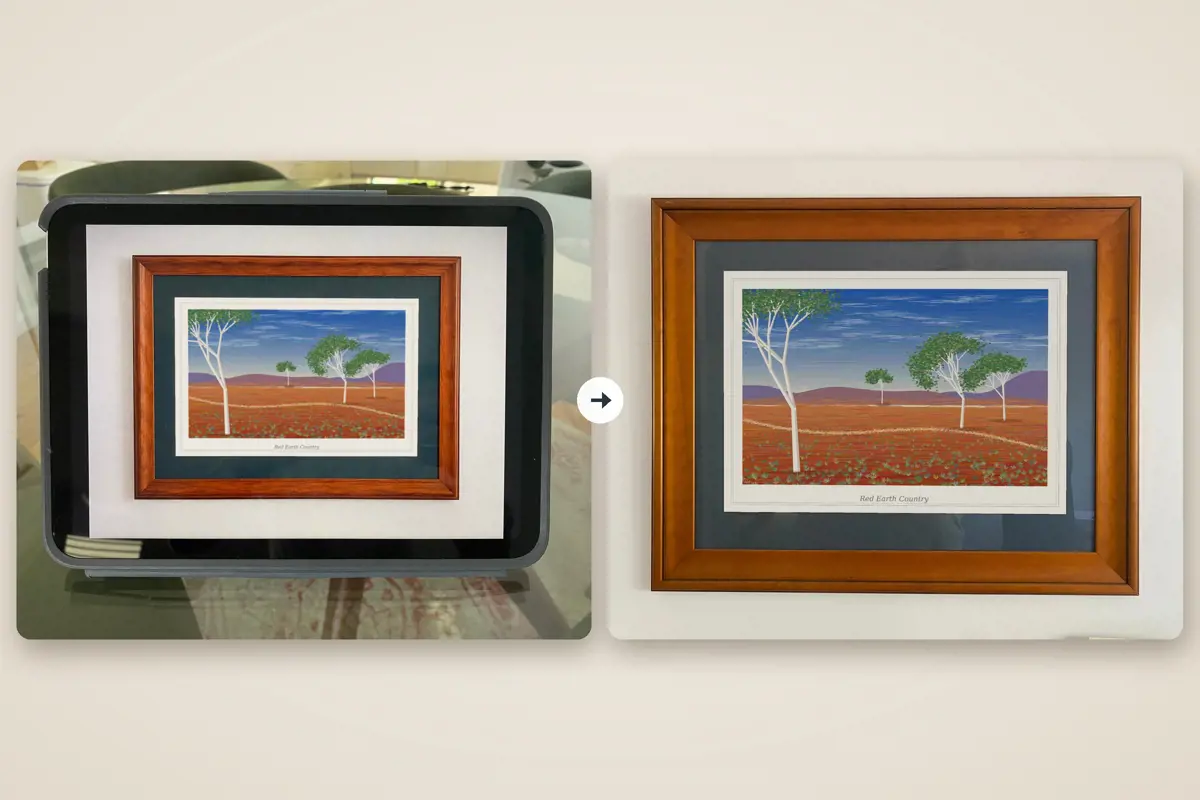
More customers than ever are arriving at our stores with framing designs created by AI, and it's easy to see why. Almost half of Australian adults (48.6%) have now used generative AI tools such as ChatGPT, Gemini and Claude, according to ANU research published in 2026. Upload a photo of your artwork, ask for ideas, and within seconds you have something that looks genuinely beautiful.
We love it. It means people are excited about framing, thinking about their artwork and exploring styles they might never have considered.
But our framers are also seeing a pattern. Many of these designs look stunning on screen, yet can't be made in real life. Some feature mouldings that don't exist. Others ignore how a frame actually holds weight, glass and artwork. So how do you get the best from AI without the disappointment?
In short: AI is a brilliant source of framing inspiration, but a design is only as good as the knowledge behind it. The most reliable AI framing advice is guided by qualified framers, based on real materials, and private by design.
What are the benefits of using AI for framing ideas?
AI gives you instant inspiration, the confidence to try new styles and an easier way to explain your taste. People everywhere are using it this way. In the UK, 61% of adults have used AI for home decorating or interior design inspiration (Barker & Stonehouse research, 2026). Among US renovating homeowners who use AI, getting design ideas (64%) and visualising concepts (58%) are the top uses (Houzz, 2026).
- Inspiration in seconds. See your artwork in a dozen different styles before you've even left the couch.
- Confidence to try something new. AI often suggests bold combinations, like coloured mats, double mounts or contrasting finishes, that people wouldn't otherwise consider.
- Helps you find your taste. Comparing options side by side makes it easier to say what you love and what you don't.
- Sound design basics. AI is often good at picking up colours from an artwork or suggesting a generous mat to give a small piece presence.
- A better conversation in store. An AI image shows our framers your vision straight away, so we can get to the good part faster.
The potential is real. The question is what the AI is working from.
Where do ChatGPT, Gemini and other AI tools fall short?
General AI tools fall short because they've never been trained on picture framing. They don't know which mouldings exist, what materials can physically do, or how your artwork looks in real light. Even in home design generally, visualisation is the area homeowners most often say falls short of expectations (26%), according to Houzz's 2026 survey. In framing, the gaps show up in a few predictable ways.
- It looks good on screen, not always on the wall. Screens are backlit and colour-enhanced. Real mouldings have grain, texture and sheen that shift with your room's lighting, so a frame that glows on your phone can look flat or darker in person.
- The frames often don't exist. AI image tools invent mouldings, finishes and profiles that no supplier makes, or that simply aren't available here in Australia.
- Structural limits are ignored. A slim moulding may not safely hold a large, heavy piece behind glass. A rebate may be too shallow for a stretched canvas or 3D object. Some mat boards are larger than standard with no oversized options. Standard mat boards measure 812 x 1016 mm (32 x 40 inches) and oversized boards 1016 x 1524 mm (40 x 60 inches), so a design that needs a bigger single mat simply can't be cut.
- Scale is approximate. Mat widths, frame widths and overall sizes rarely match your actual artwork or wall.
- It can't see the real artwork. A photo hides true colours, paper type, thickness and condition, all of which change how a piece should be mounted.
- Preservation is invisible. Acid-free mats, UV-protective glass and archival mounting don't show up in a pretty picture, but they decide whether your artwork fades or yellows over time.
- It's confidently inconsistent. Ask the same question twice and you may get two different answers, both delivered with total certainty.
What makes AI framing advice trustworthy?
AI framing advice is trustworthy when it's guided by qualified framers, based on materials that actually exist, and private by design. The problem isn't AI itself. It's AI working without the right knowledge or boundaries.
1. Guided by real framers
Good framing is a craft built on years of experience. When AI learns from the judgement of professional framers, it understands what makes a design work; proportion, balance, how a frame complements an artwork rather than competes with it, and which choices stand the test of time.
That expertise is formal, not just experience. We have a team of highly trained and qualified custom framers, most of whom have completed the nationally recognised MSF30518 Certificate III in Picture Framing as well as the ICP31220 Certificate III in Printing, and together we've helped more than 134,000 customers frame what matters to them. Research backs up the value of that human judgement: 34% of UK adults say they'd trust a combination of AI and a professional designer most (Barker & Stonehouse, 2026).
2. Grounded in real materials
The best recommendation is one you can actually buy. AI that works from a real catalogue of mouldings, mats and glazing, with real sizes, profiles and finishes, can only suggest designs that exist. It can also respect the structural rules that keep your artwork safe, flat and secure for decades.
3. Private by design
The photos we frame are often deeply personal; family portraits, wedding photos, a child's first painting, a precious original artwork. Uploading them to a general AI service can mean they're stored or used in ways you never intended. Australians are right to be cautious: the ANU's AI Adoption in Australia report found concerns about personal data are one of the main barriers to using generative AI. Framing advice should keep privacy at its core, with your images used only to help design your frame.
When these three come together, AI stops being a source of pretty pictures and becomes a genuinely reliable design partner.
How should you use AI for picture framing ideas?
Use AI for inspiration, then let a qualified framer turn the idea into something that can be built. These six tips will help you get the most from it.
- Treat it as a mood board, not a blueprint. Use AI to explore styles and colours, then let a framer translate the look. See how the custom framing process works.
- Check your privacy settings first. Before uploading personal photos or original artwork, review how the tool stores and uses your images.
- Give it real measurements. Include your artwork's actual size and where it will hang and treat any dimensions it suggests as a rough guide.
- Ask about conservation. Prompt it to consider acid-free mats and UV-protective glass, especially for originals, prints and photos you want to last. Our glass options include virtually invisible glass with 99% UV protection.
- Check whether you need custom framing at all. If your piece is a standard size, a ready-made picture frame may be all you need. If you've created the artwork itself with AI, our print and frame service can bring it to life. Just be sure to check that the file size is suitable for the print size you select.
- Bring the image in store. Show us what you love at one of our picture framing stores. We'll match the look with real mouldings and mats you can see and touch, under real light.
The future of framing design
AI is here to stay in framing, and that's exciting. The real opportunity isn't AI that imagines frames. It's AI that understands framing; trained by people who do it every day, built around materials that exist, and respectful of the personal treasures you trust it with.
That's the future we believe in, and it's closer than you might think. Watch this space.
In the meantime, bring your ideas, AI-generated or otherwise, into any of our 14 Frame Today stores. Our qualified framers will help you turn them into something beautiful that's built to last.