Updated 3 July 2026
We all have thousands of beautiful memories trapped on our smartphones and hard drives - holiday snaps, wedding portraits, and candid family moments. But nothing compares to bringing those digital files into the physical world, beautifully printed and framed on your wall.
However, if you've ever printed a photo only to find it looks blurry, or that your favourite friend got completely chopped off in the printout, you are not alone. Getting a digital file perfectly ready for a physical frame can feel like navigating a maze of technical jargon.
This comprehensive guide breaks down the printing process into simple, actionable steps so you can get gallery-quality results every single time, whether you are ordering from your couch or speaking with us in-store.
1. Master Image Resolution & DPI (no maths required)
The most common mistake when printing digital photos is ignoring resolution. Your smartphone or computer screen is incredibly forgiving; it only needs about 72 DPI (dots per inch) to look perfectly sharp to your eye.
A physical print, however, is a completely different beast. To get a crisp, clear image without visible pixels or fuzziness, the printer needs a much higher density of data - ideally 300 DPI at the final print size.
If you try to blow up a low-resolution screenshot or a compressed image sent via a messaging app into a massive poster size print, the result will look blurry and pixelated. That said, it’s also important to factor in your final viewing distance. A large statement print hanging over a staircase or across a living room doesn’t always require razor-sharp microscopic detail; your eyes naturally blend the image together from a few metres away, making slightly lower-resolution files surprisingly forgiving when viewed from afar.
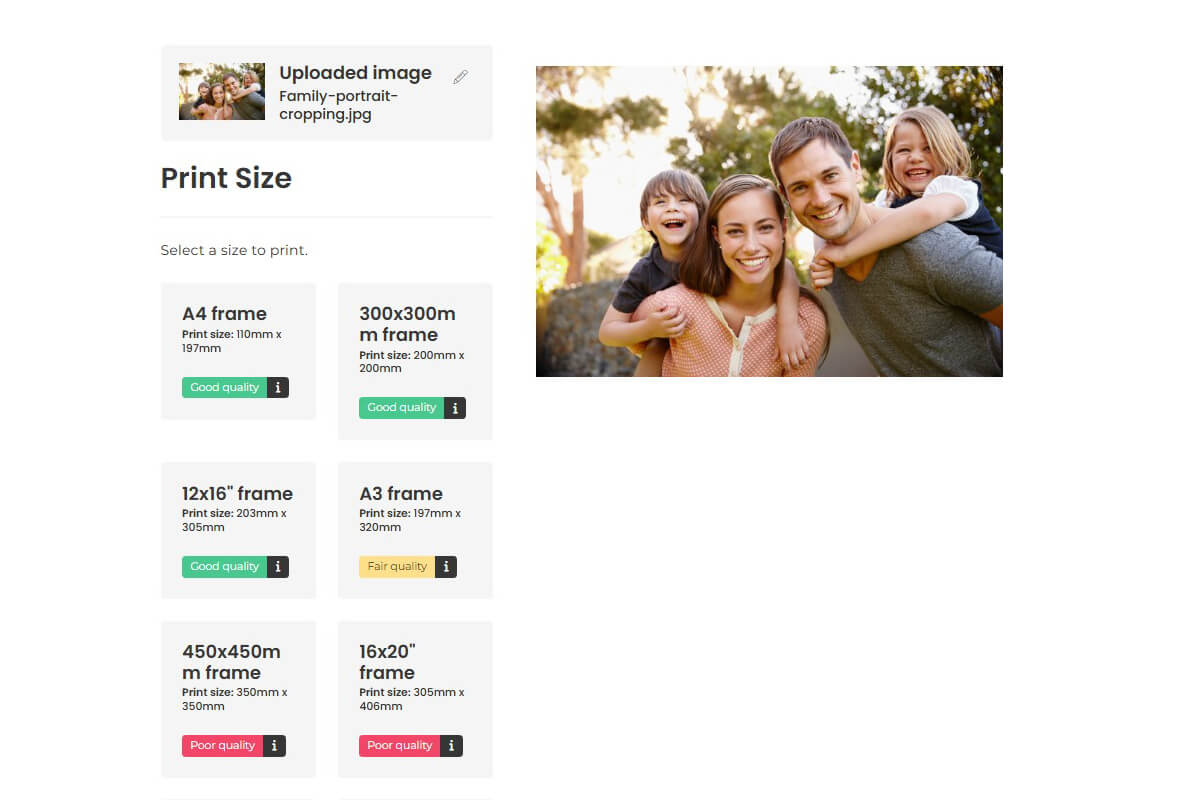
The Smart Shortcut: You don't need to do complex pixel maths before you print. When you use the Frame Today online Print + Frame tool, the smart software does the heavy lifting for you. As soon as you upload your photo, the system automatically analyses the underlying file data, identifies the image quality, and instantly tells you exactly how large you can safely print it.
2. The Aspect Ratio Trap & How to Avoid Awkward Cropping
In our stores, our framing consultants frequently meet customers who are confused about why their printed image may need to be cropped to fit a set frame size. This comes down to the aspect ratio - the relationship between the width and height of an image.
- Smartphones generally capture images in a native 4:3 ratio (a wider, more elongated rectangle).
- Traditional frame sizes and professional DSLR cameras often use a 3:2 ratio or other distinct custom dimensions.
When you try to force a 4:3 smartphone photo into a traditional frame size without planning ahead, the image's proportions have to be adjusted to fit the frame. That is, when we print, we need to crop the edges in one dimension (either top and/or bottom OR left and/or right). This is how family members at the edge of a group photo get cut out, or why beautiful landscape horizons suddenly feel cramped.
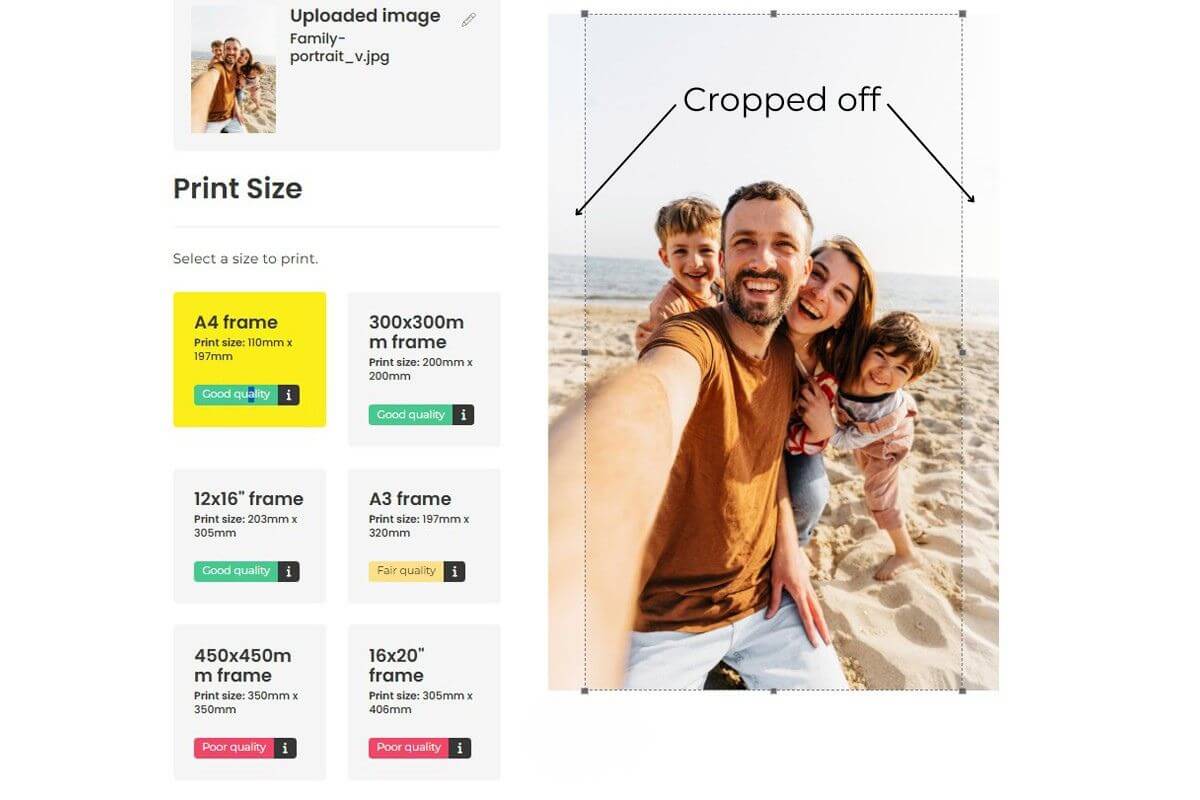
How to Stay in Control of Your Composition
Before you hit print, look at the visual composition of your photo. If you are ordering online, our Print + Frame tool includes an intuitive visual crop selector. Once you select a frame the interactive preview lets you adjust the bounding box yourself, showing you exactly what stays inside the frame and what gets cropped off before the ink ever hits the paper. If you're designing in-store, our team will sit down with you at the counter to preview the crop boundaries together.
3. Professional Digital Printing vs. Desktop Inkjets
Not all prints are created equal. It can be tempting to print a photo on a standard desktop inkjet printer at home, but consumer-grade printers use cheap, dye-based inks. These inks are highly susceptible to moisture, humidity, and the harsh Australian UV light. Within just a few years, or sometimes months, a home-printed photo will often begin to fade, shift colours, or take on an unnatural yellow or blue tint.
At Frame Today, our professional Espon wide-format digital printers use commercial-grade pigment-based archival inks. These micro-pigments bind deeply to the paper fibres, delivering exceptional colour accuracy, rich contrast, and museum-grade longevity designed to resist fading for up to 75+ years.
Our Printing & Framing Philosophy
While we occasionally accommodate standalone print-only requests, our core approach is built around a unified printing and framing philosophy. A premium print is only half the journey. By printing and framing your work as a cohesive, single process, we ensure that your artwork is immediately protected from dust, fingerprints, and structural warping. Custom picture framing seals in the quality, providing the structural backing and glass protection your memories deserve.
4. Selecting Your Paper Stock
The paper you choose fundamentally changes how light interacts with your image and how the final piece “feels” on your wall. To keep your online ordering experience smooth and predictable, our website Print + Frame tool is pre-configured with our premier all-rounder stock. However, if you are looking for a highly specialised artistic finish, visiting one of our physical stores unlocks our complete, extended Print Studio collection.
Here is a look at our professional-grade lineup and exactly where you can access them:
Available Online & In-Store
- Canson Infinity Lustre Premium 310: The perfect choice for family portraits, wedding photography, and everyday framing. This paper features a beautiful lustre finish that offers brilliant, punchy colour depth while drastically reducing the distracting glare caused by overhead room lighting behind the frame glass. It is fade-resistant to ensure the maximum lifespan and conservation of your prints
Exclusively Available In-Store
- Canson Infinity Rag Photographique 310: A premium, museum-grade, 100% cotton rag fine art paper with a smooth, ultra-matte texture. This stock is highly favoured by local artists and landscape photographers because it provides absolute detail with one of the highest achievable Dmax levels on the market for outstanding depth in fine art photography and printmaking.
- GamutMatte Coated Inkjet Paper 230: High-performance, heavyweight matte paper that delivers crisp lines and highly vivid contrast. At 230gsm, it is the perfect choice for graphic prints, modern illustrations, travel posters, and clean, contemporary typography layouts.
- Canson PhotoArt Matte 395 Pro Canvas: Top grade professional canvas developed to ensure the highest standard and accuracy for colour and black & white fine art and photographic reproductions. Perfect for making a bold, textured statement and the ideal option for a contemporary look without a traditional picture frame and glass.
5. Designing Your Complete Frame
Once your image quality is verified, the crop is set, and your premium paper is chosen, you reach the creative finish line… designing the frame.
The frame you select acts as the bridge between your photograph and the interior design of your room. You can choose a slim, minimalist black or white frame for a modern edge, or a warm, natural oak timber to bring out the earthy tones in an outdoor landscape.
Don't forget the power of including a matboard (the border that sits between the picture and the frame). Adding a white mat board not only draws the viewer's eye directly into the centre of the image, but it also creates physical breathing room, elevated separation, and an undeniable gallery-quality finish.

Ready to bring your photos to life?
You can upload your files, test your image resolution, and design your entire frame instantly using our online Print + Frame Studio.
If you prefer to touch the premium paper and canvas stocks in person, or if you want an expert eye to help you manage a tricky aspect ratio crop, simply drop into any of our stores across Sydney, Brisbane, Newcastle, the Central Coast, the Hunter Valley, or the Southern Highlands. Our framing consultants are always ready to help you turn a digital file into a lifelong centrepiece.