When you invest in custom picture framing, you are trusting someone with a valuable piece of art, delicate family heirloom, or irreplaceable memory. However, a common misconception is that picture framing is just a basic retail skill learned on the fly. The reality?
Picture framing is a highly technical, government-recognised trade in Australia. Handing your artwork over to an untrained, unaccredited hobbyist can lead to irreversible chemical and physical damage.
Here are 3 key reasons why choosing a trade-qualified professional is the only way to truly protect your investment.
1. Framing is a Government Recognised Trade
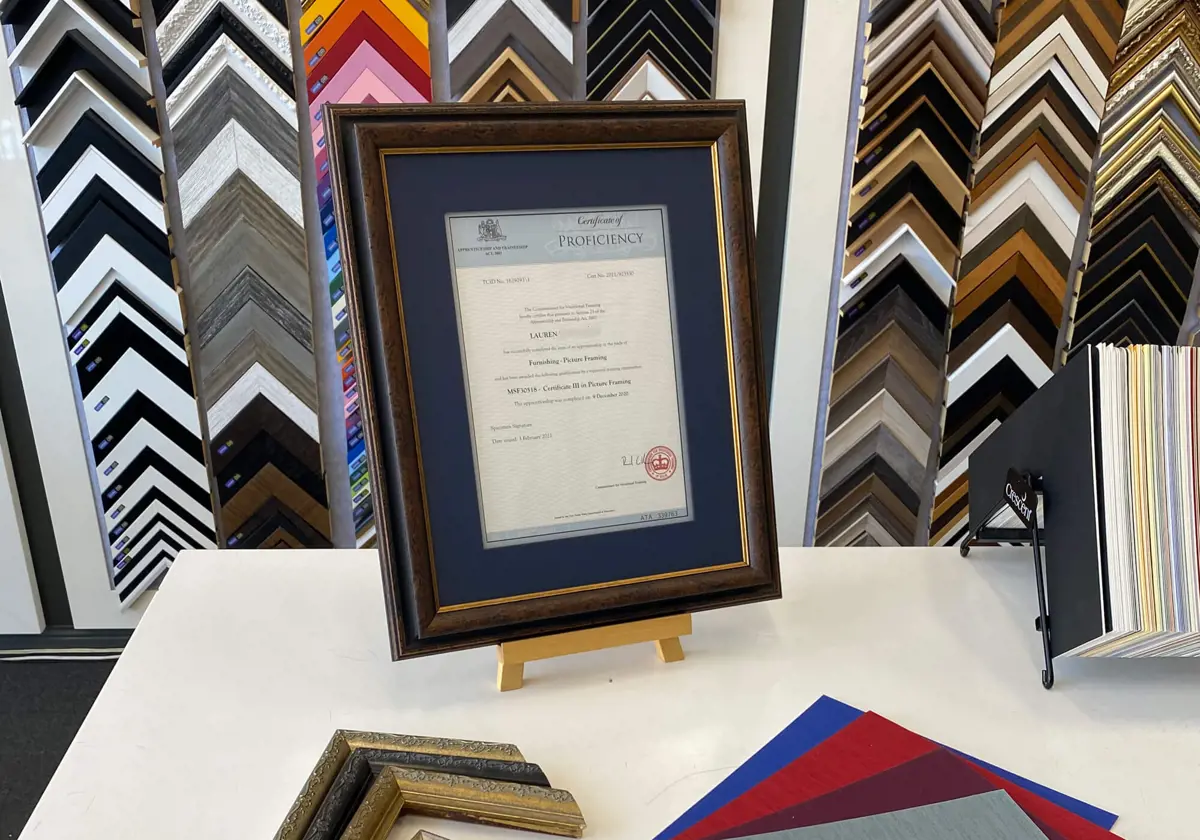
In Australia, professional picture framing is regulated under national training frameworks. A fully qualified professional holds a Certificate III in Picture Framing (MSF30518), a formal qualification under the Australian Government guidelines.
To achieve this trade qualification, framing professionals undergo rigorous, supervised onsite training over several years. This covers:
- Advanced geometric measurement and material structural engineering.
- The chemical properties of adhesives, timber, polymers, and glass.
- Museum-grade preservation and conservation techniques.
When you use an unaccredited framer, you are essentially letting an unlicensed amateur experiment on your artwork.
2. Preventing "Invisible" Artwork Damage
A poorly constructed frame doesn’t just look bad; it can actively destroy what is inside it. Cheap materials and incorrect techniques cause slow, irreversible decay over time.
Trade-qualified framers are trained to prevent the major catalysts of artwork degradation:
- Acid burning and yellowing: Untrained framers often use standard, wood-pulp matboards containing lignin. Over time, this releases acid, causing permanent brown burn marks on your art. Qualified tradespeople use acid-free alpha-cellulose or cotton rag boards.
- Irreversible mounting: Using standard sticky tape or aggressive commercial glues can ruin an artwork instantly. A qualified framer uses reversible, museum-grade hinging techniques that can be undone without harming the paper.
- Moisture trapping and mould: If art directly touches the glass, changes in temperature create condensation, leading to mould growth and the paper sticking permanently to the glazing. Professionals use precise spacer depths or matboards to ensure air flows correctly.
3. The Hidden Cost of Ad-Hoc Training
Many budget framing outlets rely on casual staff or contractors who receive ad-hoc, unmonitored training on the shop floor. While they might learn how to operate a basic chopper or joiner, they miss the deep structural and material knowledge taught in a formal apprenticeship.
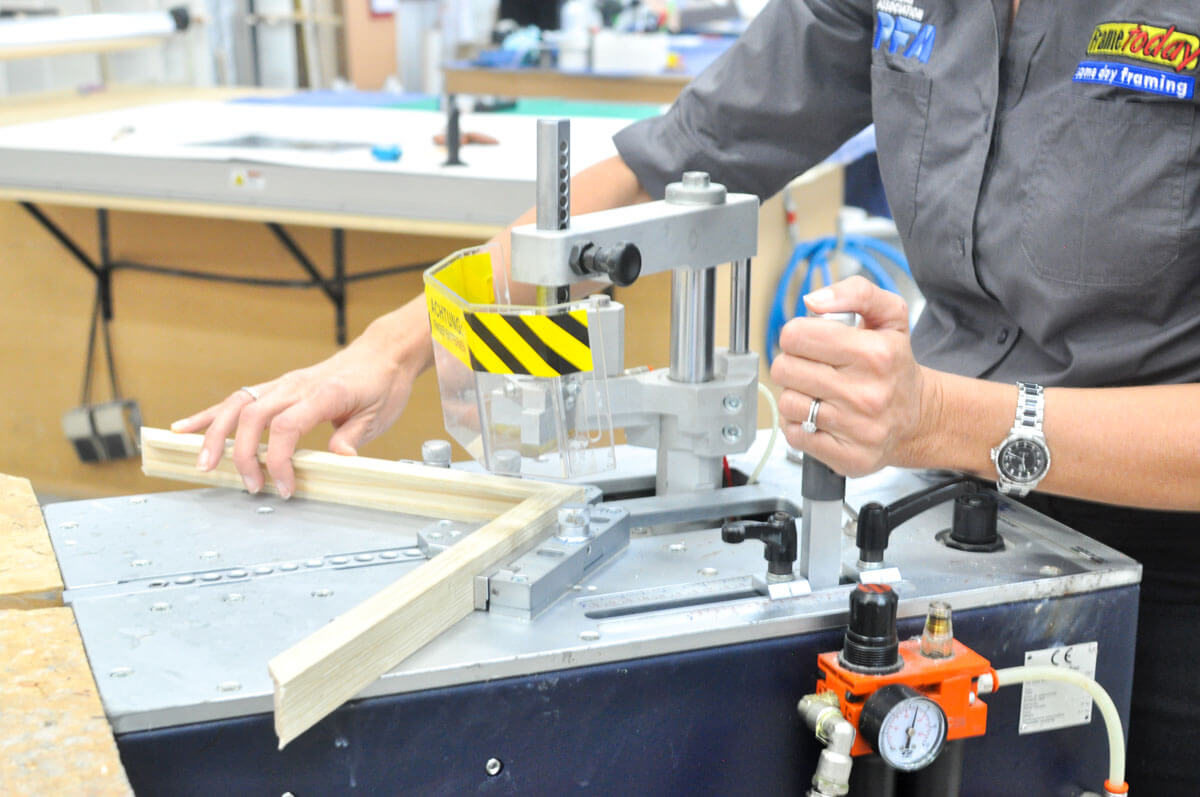
Bad habits get passed down from one untrained worker to the next. This results in misaligned corners (mitres) that split open after a change in seasonal humidity, or frames that bow and warp under the weight of heavy glass.
Performance Criterion | Trade-Qualified Framer (Cert III) | Unaccredited / Ad-Hoc Retailer |
Training Standards | Government-audited national curriculum (MSF30518) | Informal, unverified in-store tips |
Experience Foundation | Multi-year supervised trade apprenticeship | Varied (often days or weeks of casual experience) |
Preservation Knowledge | Full technical mastery of archival chemistry | Focus is solely on superficial aesthetics |
Structural Integrity | Engineered to support weight & resist humidity | Prone to corner splitting and frame warping |
Total Peace of Mind Backed by Our Lifetime Guarantee
Choosing a framer who employs staff trained under the formal Certificate III apprenticeship framework ensures consistency. Every single piece is treated with standard-compliant craftsmanship.
Because a qualified trade professional builds the frame using correct structural engineering and material matching, the work is built to last. This allows premium providers to confidently back their craftsmanship (like our Lifetime Guarantee), something an unaccredited framer simply cannot match.
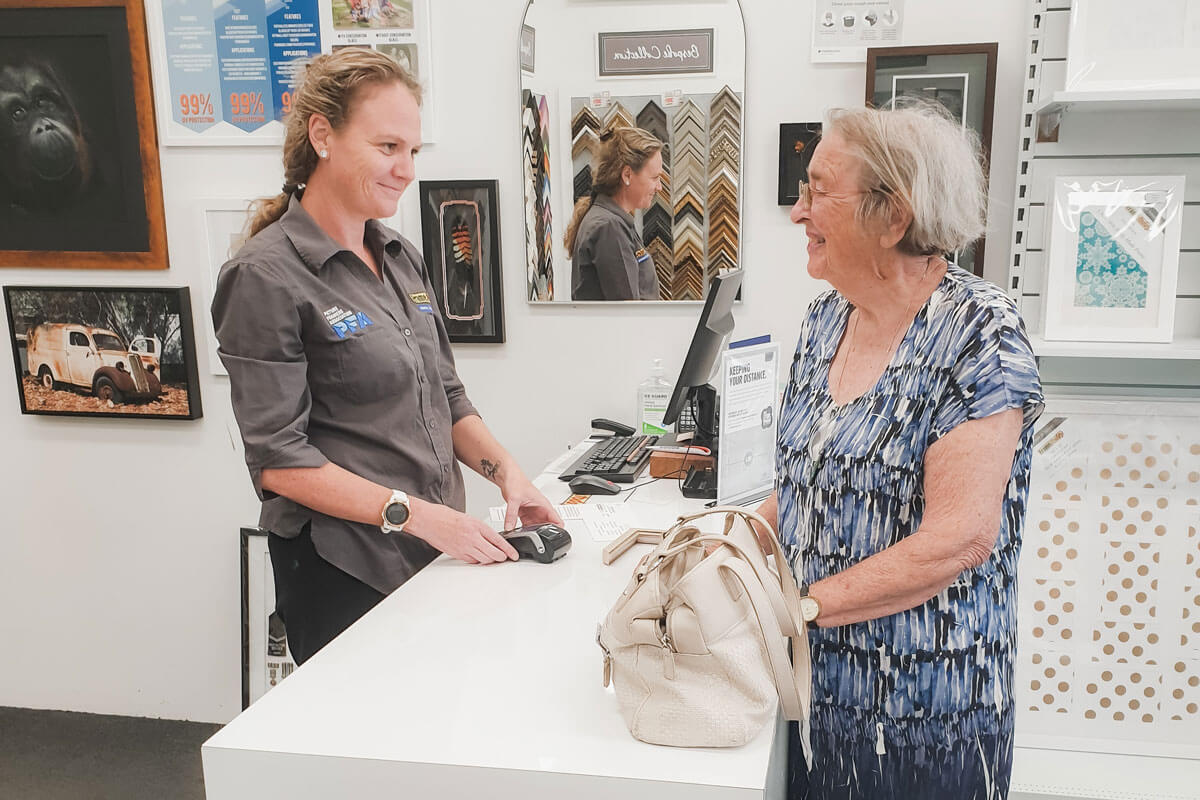
Before you hand over your next artwork, memento, or handicraft, ask a simple question: Are your framers qualified? Your artwork deserves a trade-qualified professional.